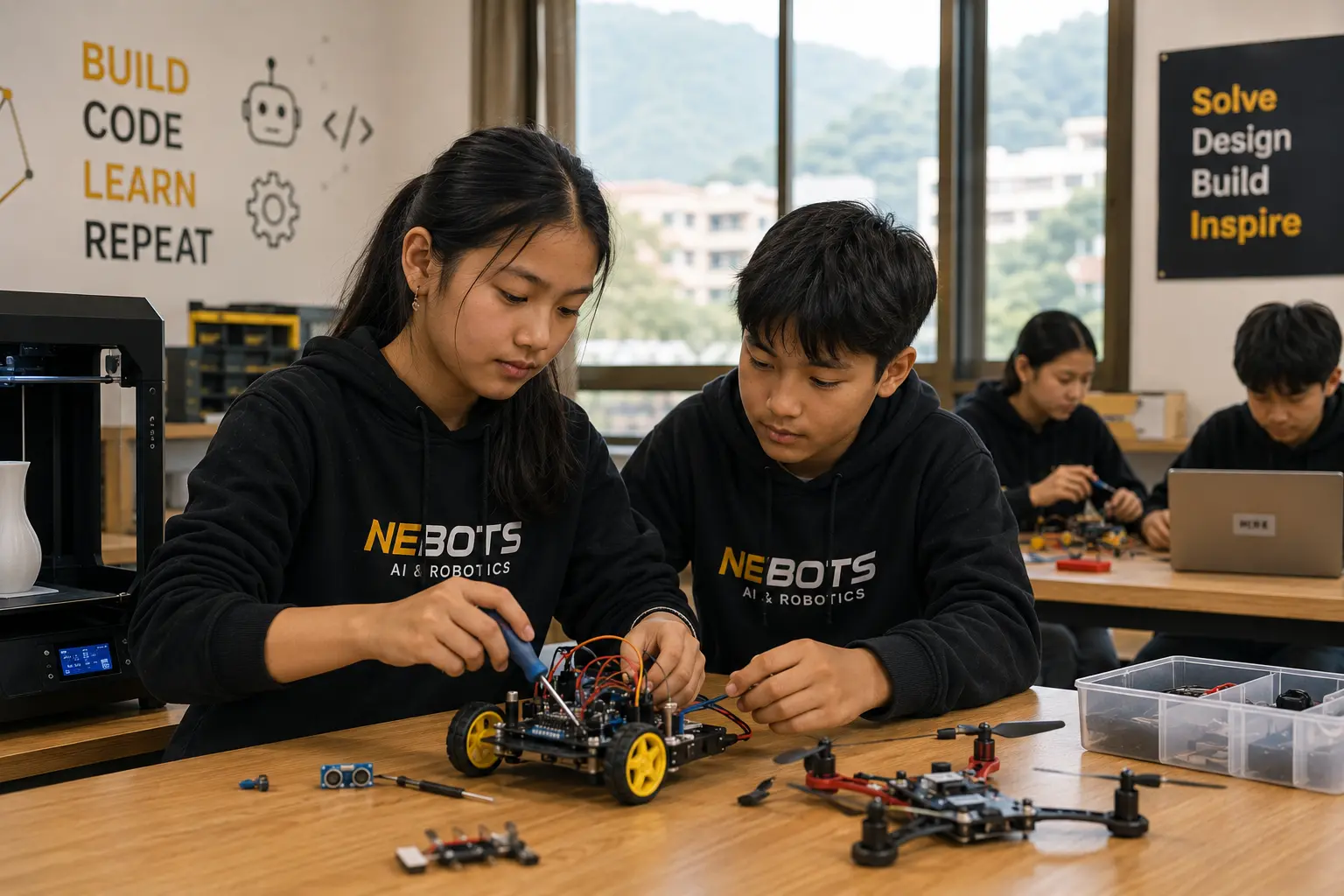
For decades, learning in India meant memorising chapters and repeating them in an exam. But the world your child is growing into rewards a different skill: the ability to build, test and improve real things. This is exactly what hands-on STEM education delivers, and it is why more parents and schools across North East India are moving from slideshows to soldering irons.
What is hands-on STEM education?
STEM stands for Science, Technology, Engineering and Mathematics. Hands-on STEM education means students learn these subjects by doing: wiring a circuit, coding a game, assembling a drone or 3D-printing a design. Instead of reading about how a motor works, a child builds a robot that moves. The concept sticks because it was discovered, not recited.
Why hands-on learning beats rote memorisation
Memorised facts fade fast. Skills built with your hands last. When a student debugs their own code or fixes a robot that will not turn, they practise problem-solving, patience and creativity, the exact traits employers and universities look for.
- Deeper understanding: building a concept beats reading about it
- Real problem-solving: mistakes become lessons, not failures
- Confidence: a child who builds a working robot believes they can build anything
- Future-ready skills: robotics, AI, drones and coding are the skills of the next decade
Hands-on STEM and NEP 2020
India's National Education Policy 2020 explicitly calls for experiential, skill-based and activity-driven learning. Hands-on STEM programs answer that mandate directly, giving schools a practical way to move beyond textbooks and prepare students for a technology-first future.
Children who build things today will build the region tomorrow.
How to get your child started
The best way to know if hands-on STEM is right for your child is to let them try it. A single demo class where they build something real tells you more than any brochure. NEbots offers free demo classes across the North East so students can experience learning by building before they commit.