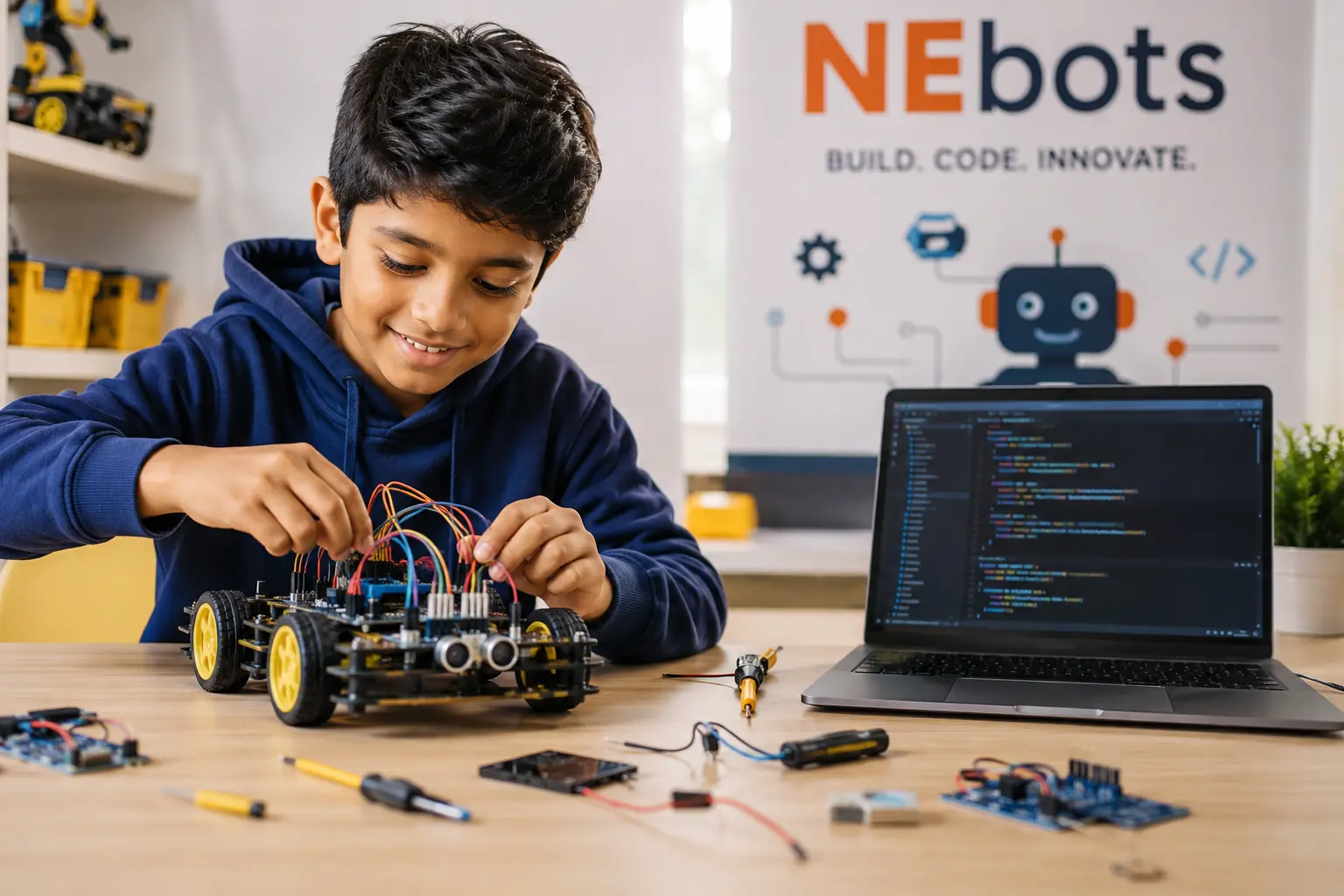
Robotics is the flagship NEbots course, and for many students it is the moment technology stops feeling like magic and starts feeling like something they can build. From the very first session, children wire real circuits, mount real motors and write the code that brings a machine to life. There are no simulations to watch and no slides to copy, only real builds that move, sense and respond.
Who the robotics course is for
The course is designed for children from age 8 and up, and no prior experience with electronics or coding is needed. Each level is paced for its age group, so a curious 8-year-old and a confident 14-year-old both stay challenged. If your child likes taking things apart, asking how things work, or building with their hands, robotics is a natural fit.
What your child will build
Over a first level, students do not just learn about robots, they build a series of working machines they can keep. Typical builds include:
- A motorised robot that drives, turns and follows commands
- A line-following robot that steers itself along a track
- An obstacle-avoiding rover with ultrasonic sensors for eyes
- A grabber arm for the end-of-course Robo Games
The 12-week roadmap
Each level runs across 12 sessions and follows a clear journey, so students always know what they are working toward:
1. Meet your kit
Students open the box, learn every part by touching it, and light up their first circuit on day one.
2. Make it move
Motors, wheels and power come together into a driving bot in week one, which students then race.
3. Give it senses
Ultrasonic and infrared sensors let the robot see lines and dodge obstacles, turning a machine into something that reacts to its world.
4. Code the brain
Students program behaviours: follow, avoid, decide. The logic is theirs, and so are the robot's moves.
5. Robo Games
The level ends with a showcase day where robots race, navigate mazes and grab objects while parents watch.
The kit is yours to keep
The robotics kit, including motors, sensors, a controller board and chassis, is included in the course. Students keep the projects they build during take-home sessions, so the learning does not stop when class ends.
Skills that outlast the course
Robotics teaches far more than robotics. When a student debugs their own code or fixes a robot that will not turn, they practise the skills that matter for life:
- Problem-solving through real trial and error
- Coding and logical thinking
- Design, patience and attention to detail
- The confidence that comes from building something that works
Children who build things today will build the region tomorrow.
The best way to see if robotics is right for your child is to let them try. NEbots runs free robotics demo classes across North East India, where students build something real in their very first session.